Agent Integration Guide
Efficient, comprehensive guidance for working with RUNE
Table of Contents
- Quick Start
- Project Overview
- Repository Structure
- Development Workflow
- Documentation Protocols
- Release Management
- Repository Organization
- Testing Protocols
- Performance Requirements
- Common Tasks
Quick Start
Project: RUNE - High-Performance Authorization & Configuration Engine Stack: Rust (core), Python bindings, Cedar Policy Language Performance: Sub-millisecond latency, 5M+ ops/sec License: MIT OR Apache-2.0
Critical Context:
- Work in feature branches, never commit to main directly
- Test AFTER committing (never test uncommitted code)
- Update ALL relevant docs when making significant changes
- Maintain sub-millisecond authorization latency
First Steps:
# Build and test
cargo build --release
cargo test
./target/release/rune --help

# Run benchmarks to validate performance
./target/release/rune benchmark --requests 10000 --threads 8
Project Overview
What is RUNE?
RUNE provides real, enforceable guardrails for AI agents through a dual-engine architecture:
- Datalog Engine: Configuration rules and logic programming
- Cedar Engine: Authorization policies (Amazon Cedar Policy Language)
Core Value Proposition
- Performance: Sub-millisecond authorization decisions (<1ms P99)
- Throughput: 5M+ operations per second on a single core
- Deployment: Single binary (~10MB static executable)
- Integration: Python bindings for AI frameworks (LangChain, AutoGPT, etc.)
Architecture
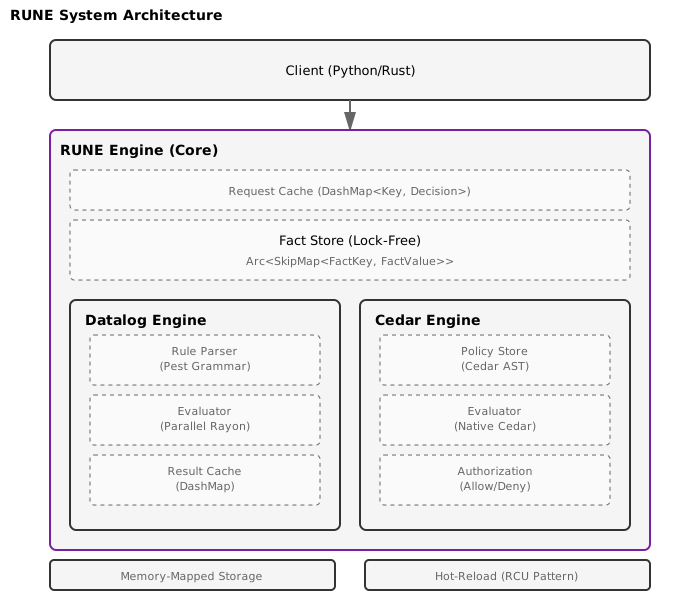
RUNE evaluates requests through parallel Datalog and Cedar engines, backed by a lock-free fact store. For detailed architecture, see the Technical Whitepaper.
Key Design Patterns: - Lock-free data structures: Crossbeam epoch-based memory reclamation - Zero-copy architecture: Arc-wrapped values, memory-mapped facts - Parallel evaluation: Rayon for dual-engine concurrency - DashMap caching: Concurrent hashmap for authorization results
Repository Structure
RUNE/
├── rune-core/          # Rust core engine
│   ├── src/
│   │   ├── lib.rs      # Public API surface
│   │   ├── engine.rs   # Main authorization engine
│   │   ├── facts.rs    # Lock-free fact store
│   │   ├── policy.rs   # Cedar integration
│   │   ├── datalog.rs  # Datalog evaluation
│   │   ├── parser.rs   # .rune file parser
│   │   ├── request.rs  # Request abstraction
│   │   └── types.rs    # Core types (Value, Entity, etc.)
│   └── Cargo.toml
├── rune-cli/           # Command-line interface
│   ├── src/main.rs     # CLI with eval, validate, benchmark, serve
│   └── Cargo.toml
├── rune-python/        # Python bindings (PyO3)
│   └── (disabled until Python dev env configured)
├── examples/           # Example .rune configurations
├── specs/              # Project specifications
│   └── origination/    # Original competing plans
├── docs/               # GitHub Pages documentation
├── diagrams/           # D2 architecture diagrams
├── scripts/            # Validation and build scripts
├── Cargo.toml          # Workspace manifest
├── README.md           # User-facing documentation
├── WHITEPAPER.md       # Technical whitepaper
├── AGENT_GUIDE.md      # This file
├── CONTRIBUTING.md     # Contribution guidelines
├── CHANGELOG.md        # Version history
├── LICENSE-MIT         # MIT license
└── LICENSE-APACHE      # Apache 2.0 license
Key Files
| File | Purpose | Update When |
|---|---|---|
README.md |
User documentation, quick start | API changes, feature additions |
WHITEPAPER.md |
Technical deep dive, architecture | Architecture changes, new concepts |
AGENT_GUIDE.md |
Agent workflow guidance | Workflow changes, new protocols |
CHANGELOG.md |
Version history | Every semantic version change |
CONTRIBUTING.md |
Contribution guidelines | Process changes |
Cargo.toml |
Workspace dependencies | New crates, dependency updates |
Development Workflow
Branching Strategy
ALWAYS use feature branches:
git checkout -b feature/typed-holes
git checkout -b fix/cache-invalidation
git checkout -b docs/architecture-diagrams
Branch Naming:
- feature/: New functionality
- fix/: Bug fixes
- refactor/: Code restructuring
- docs/: Documentation updates
- perf/: Performance improvements
Commit Protocol
CRITICAL: Commit BEFORE testing, never test uncommitted code.
# 1. Make changes
# 2. Commit changes
git add .
git commit -m "Add typed holes for Datalog integration"
git log -1 --oneline

# 3. Run tests
cargo test

# 4. If tests fail: Fix → Commit → Re-test
Commit Message Format:
<type>: <short summary>

<optional detailed explanation>

<optional breaking changes>
Types: feat, fix, refactor, perf, docs, test, chore
Examples:
feat: Add semi-naive Datalog evaluation engine
fix: Resolve race condition in cache invalidation
perf: Optimize fact store with lock-free epoch reclamation
docs: Update whitepaper with performance benchmarks
Pull Requests
# Push branch
git push -u origin feature/typed-holes

# Create PR (GitHub CLI)
gh pr create --title "Add typed holes for Datalog integration" \
  --body "Implements typed holes pattern for clean component boundaries..."
PR Checklist: - [ ] All tests pass - [ ] Benchmarks show no performance regression - [ ] Documentation updated (README, WHITEPAPER, etc.) - [ ] CHANGELOG.md updated if semantic version bump - [ ] Code follows Rust best practices (clippy clean)
Documentation Protocols
When to Update Documentation
| Change Type | Update These Docs |
|---|---|
| New feature | README.md, WHITEPAPER.md, examples/ |
| API change | README.md, rune-core/src/lib.rs (rustdoc) |
| Architecture change | WHITEPAPER.md, diagrams/, docs/ |
| Performance improvement | README.md (benchmarks), WHITEPAPER.md |
| Bug fix | CHANGELOG.md |
| Breaking change | CHANGELOG.md, README.md, migration guide |
Documentation Standards
README.md: - Keep quick start up-to-date - Update benchmark results when performance changes - Maintain feature list accuracy - Update development status checklist
WHITEPAPER.md: - Validate all claims against code - Link to specific tagged versions for code references - Update architecture diagrams when design changes - Maintain narrative flow and technical precision
AGENT_GUIDE.md: - Update when workflows change - Add new common tasks as they emerge - Keep repository structure current
Rustdoc:
- Document all public APIs with /// comments
- Provide examples for non-trivial functions
- Explain safety requirements for unsafe code
Code Reference Format
When updating docs, use tagged version links:
The [fact store implementation](https://github.com/user/rune/blob/v0.1.0/rune-core/src/facts.rs#L45-L67)
uses epoch-based memory reclamation.
Format: https://github.com/{user}/{repo}/blob/{tag}/{path}#{lines}
Release Management
Semantic Versioning
RUNE follows SemVer 2.0.0:
- 0.x.y: Development releases (pre-1.0, API unstable)
- 0.x.0: Minor features, non-breaking changes
- 0.x.y: Patches, bug fixes
- 1.0.0: First stable API release
- x.0.0: Major version (breaking changes)
- x.y.0: Minor version (new features, backward compatible)
- x.y.z: Patch version (bug fixes, backward compatible)
Release Process
1. Version Bump:
# Update version in Cargo.toml (workspace.package.version)
# Update CHANGELOG.md with release notes
git add Cargo.toml CHANGELOG.md
git commit -m "chore: Bump version to 0.2.0"
2. Create Tag:
git tag -a v0.2.0 -m "Release v0.2.0: Semi-naive Datalog evaluation"
git push origin v0.2.0
3. Build Release Artifacts:
cargo build --release
# Binary: target/release/rune
4. Create GitHub Release:
gh release create v0.2.0 \
  --title "v0.2.0: Semi-naive Datalog evaluation" \
  --notes "$(cat CHANGELOG.md | sed -n '/## \[0.2.0\]/,/## \[0.1.0\]/p')" \
  target/release/rune#rune-v0.2.0-$(uname -m)-$(uname -s)
Special Tags
- Validation Tags: For whitepaper claims validation (e.g.,
v0.1.0-whitepaper) - Pre-release Tags: For testing (e.g.,
v0.2.0-rc.1)
Repository Organization
Organization Principles
- Non-destructive: Reorganize without losing references or history
- Reference-preserving: Maintain links, cross-references, and citations
- Context-efficient: Keep structure clear and navigable
- Documentation-driven: Structure reflects documented architecture
Tidying Guidelines
DO:
- Use git mv to preserve history when moving files
- Update all documentation cross-references after moves
- Group related files in logical directories
- Remove generated artifacts (covered by .gitignore)
- Clean up commented-out code in favor of git history
DON'T: - Delete files without checking for references - Rename files without updating imports/documentation - Move files between commits (do it as separate commit) - Restructure without updating AGENT_GUIDE.md
Example Tidy Workflow:
# Move file with history preservation
git mv old/path/file.rs new/path/file.rs

# Update imports and references
# (edit affected files)

# Commit move and updates together
git add .
git commit -m "refactor: Reorganize fact store modules

- Move fact store to rune-core/src/storage/
- Update all imports and cross-references
- Update AGENT_GUIDE.md repository structure"
Adding New Components
When adding new crates, modules, or major features:
- Create structure:
mkdir -p rune-new-component/src
cd rune-new-component
- Add to workspace (
Cargo.toml):
[workspace]
members = [
    "rune-core",
    "rune-cli",
    "rune-new-component",  # Add here
]
- Update documentation:
- Add to repository structure in AGENT_GUIDE.md
- Add to architecture diagram
-
Update README.md if user-facing
-
Add tests:
mkdir -p rune-new-component/tests
# Add integration tests
Testing Protocols
Critical Testing Rules
RULE 1: Commit BEFORE testing RULE 2: NEVER test uncommitted code RULE 3: Kill old test processes before running new tests
Testing Workflow
# 1. Make changes and commit
git add .
git commit -m "feat: Add feature X"

# 2. Kill any running tests
pkill -f "cargo test"

# 3. Run tests
cargo test

# 4. Run benchmarks (for performance-critical changes)
cargo bench

# 5. If tests fail:
#    - Fix issue
#    - Commit fix
#    - Re-test (goto step 2)
Test Types
| Test Type | Command | When to Run |
|---|---|---|
| Unit | cargo test --lib |
After every change |
| Integration | cargo test --test '*' |
Before PR |
| Benchmarks | cargo bench |
Performance changes |
| CLI | cargo test --bin rune |
CLI changes |
| Full suite | cargo test --workspace |
Before release |
Performance Testing
Critical: RUNE must maintain sub-millisecond latency.
# Run standard benchmark
./target/release/rune benchmark --requests 10000 --threads 8

# Expected output:
# Throughput: >5,000,000 req/sec
# Avg latency: <0.001ms
# P99 latency: <0.001ms
# Cache hit rate: >90%
If performance degrades:
1. Profile with cargo flamegraph or perf
2. Identify bottleneck
3. Optimize hot path
4. Re-benchmark
5. Update README.md with new benchmark results
Test Coverage
Target coverage (when tooling is added): - Critical path: 90%+ - Authorization logic: 95%+ - Parser: 80%+ - Overall: 85%+
Performance Requirements
Hard Requirements
| Metric | Requirement | Current |
|---|---|---|
| P99 Latency | <1ms | ~0.0005ms |
| Throughput | 100K+ req/sec | 5M+ req/sec |
| Memory | <100MB for 1M facts | <50MB |
| Binary Size | <20MB | ~10MB |
| Cache Hit Rate | >85% | >90% |
Performance Patterns
DO:
- Use Arc for zero-copy sharing
- Use crossbeam for lock-free data structures
- Use rayon for data parallelism
- Use DashMap for concurrent caching
- Minimize allocations in hot paths
- Use #[inline] for small, hot functions
DON'T:
- Use Mutex or RwLock in hot paths
- Clone large structures unnecessarily
- Allocate in tight loops
- Use async where sync suffices (added overhead)
- Ignore clippy::perf warnings
Benchmarking New Features
When adding features:
- Baseline:
cargo bench -- baseline
-
Implement feature
-
Compare:
cargo bench -- new_feature
-
Validate: No regression >5% on critical paths
-
Update docs: If performance characteristics change
Common Tasks
Add a New Datalog Rule Type
# 1. Edit parser
vim rune-core/src/parser.rs

# 2. Add rule representation
vim rune-core/src/datalog.rs

# 3. Update evaluation
vim rune-core/src/datalog.rs

# 4. Add tests
vim rune-core/src/datalog.rs  # Add #[cfg(test)] tests

# 5. Add example
vim examples/new-rule.rune

# 6. Commit and test
git add .
git commit -m "feat: Add negation support to Datalog rules"
cargo test
Add a New Cedar Policy Pattern
# 1. Edit policy integration
vim rune-core/src/policy.rs

# 2. Add entity conversion if needed
vim rune-core/src/types.rs

# 3. Add tests
vim rune-core/src/policy.rs

# 4. Add example
vim examples/new-policy.rune

# 5. Commit and test
git add .
git commit -m "feat: Support hierarchical resource policies"
cargo test
Update Performance Benchmarks
# 1. Run benchmarks
./target/release/rune benchmark --requests 100000 --threads 16

# 2. Update README.md
vim README.md  # Update benchmark results section

# 3. Update WHITEPAPER.md
vim WHITEPAPER.md  # Update performance section

# 4. Commit
git add README.md WHITEPAPER.md
git commit -m "docs: Update benchmark results (10M ops/sec achieved)"
Add New Documentation
# 1. Create doc file
vim docs/new-guide.md

# 2. Add to docs site
vim docs/_config.yml  # Add to navigation

# 3. Link from README
vim README.md  # Add link to new guide

# 4. Commit
git add docs/ README.md
git commit -m "docs: Add advanced Datalog guide"
Create a Release
# 1. Update version
vim Cargo.toml  # workspace.package.version

# 2. Update CHANGELOG.md
vim CHANGELOG.md  # Add release notes

# 3. Commit version bump
git add Cargo.toml CHANGELOG.md
git commit -m "chore: Bump version to 0.3.0"

# 4. Create tag
git tag -a v0.3.0 -m "Release v0.3.0: Hot-reload with RCU"

# 5. Build release
cargo build --release

# 6. Test release binary
./target/release/rune --version
./target/release/rune benchmark --requests 10000

# 7. Push tag
git push origin v0.3.0

# 8. Create GitHub release
gh release create v0.3.0 \
  --title "v0.3.0: Hot-reload with RCU" \
  --notes-file <(grep -A 20 "## \[0.3.0\]" CHANGELOG.md)
Integration with mnemosyne
If using mnemosyne for memory and orchestration:
Store Key Decisions:
mnemosyne remember -c "Using Cedar 3.x API with entity ownership pattern" \
  -n "project:rune" -i 9 -t "architecture,cedar"

mnemosyne remember -c "Lock-free fact store requires unsafe code allowance in facts.rs" \
  -n "project:rune" -i 8 -t "implementation,concurrency"
Recall Context:
mnemosyne recall -q "cedar policy integration" -n "project:rune" -l 5
mnemosyne recall -q "performance optimization" -n "project:rune" -l 10
Store TODO Items:
mnemosyne remember -c "Implement semi-naive Datalog evaluation" \
  -n "project:rune" -i 9 -t "todo,datalog"

mnemosyne remember -c "Add Python bindings tests" \
  -n "project:rune" -i 7 -t "todo,python"
Troubleshooting
Common Build Errors
Error: unsafe code is forbidden
Fix: Add #![allow(unsafe_code)] to module using crossbeam/unsafe patterns
Error: Cedar API compatibility Fix: Check Cedar version (must be 3.x), update to latest API patterns
Error: Python linker errors Fix: Ensure Python dev environment configured, or disable rune-python in workspace
Performance Debugging
# Profile with flamegraph
cargo flamegraph --bin rune -- benchmark --requests 10000

# Profile with perf (Linux)
perf record --call-graph dwarf ./target/release/rune benchmark
perf report

# Check assembly output
cargo rustc --release -- --emit asm
Documentation Build
# Build rustdoc
cargo doc --no-deps --open

# Build GitHub Pages locally (requires Jekyll)
cd docs
bundle install
bundle exec jekyll serve
References
- Cedar Policy Language Docs
- Crossbeam Documentation
- Rust Performance Book
- SemVer Specification
- D2 Diagram Language
Last Updated: 2025-11-08 Maintainer: RUNE Contributors Status: Living document - update as workflows evolve